Big thanks to Selah Janel for having me over for a guest blog…
Women in Horror: Sumiko Saulson: How to Turn Your Daughter Into a Horror Writer.

Big thanks to Selah Janel for having me over for a guest blog…
Women in Horror: Sumiko Saulson: How to Turn Your Daughter Into a Horror Writer.
 This interview is being included in the 2013 Women in Horror Interview Series. Every February, Women in Horror Recognition Month (WiHM) assists underrepresented female genre artists in gaining opportunities, exposure, and education through altruistic events, printed material, articles, interviews, and online support. You can find out more about WiHM here:
http://www.womeninhorrormonth.com/
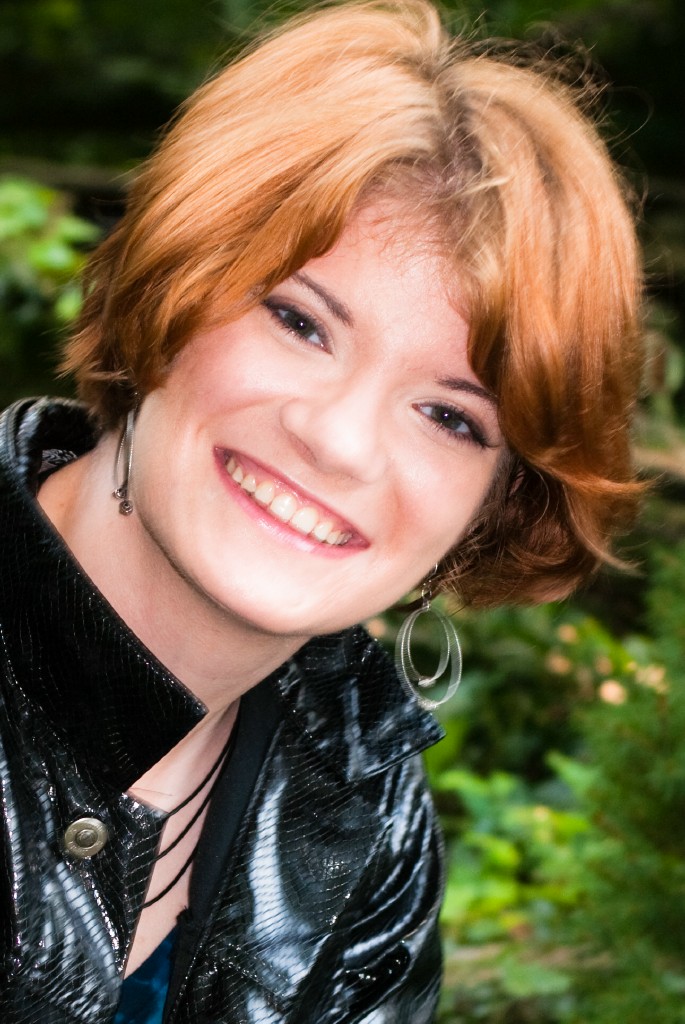
Selah Janel
Selah Janel is fueled by a love of ideas, stories, and the potential of magic hiding in the mundane. She mostly writes fantasy and horror, but is known to stray into other genres if the idea is there. She is the author of several short e-books with No Boundaries Press and one with Mocha Memoirs Press. Her first novel, the urban fantasy story In the Red, blends dark fantasy with fairy tale themes and rock n’ roll. Her work has also been included in The MacGuffin, The Realm Beyond, Stories for Children Magazine, and several upcoming anthologies. She is currently working on the first book in her cross-genre fantasy series The Kingdom City Chronicles with Seventh Star Press, titled Olde School. A Midwest girl at heart, she’s also worked as a performer, puppeteer, and in costume design and construction. Feel free to keep up with her in the following places
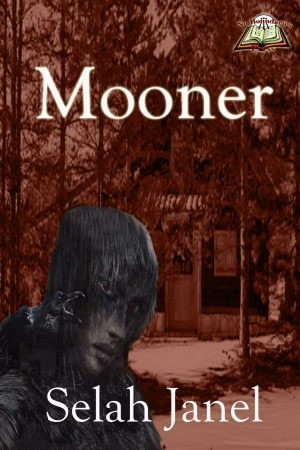
Like many young men at the end of the 1800s Bill has signed on to work in a logging camp to earn a fast paycheck to start his life. Unfortunately his role model is Big John, the camp’s golden boy known for blowing his pay as fast as he makes it. On a cold Saturday night they enter Red’s Saloon to forget the work that takes the sweat and the lives of so many. Red may have plans for their whiskey money, but something else lurks in the shadows, something that badly wants a drink that has nothing to do with alcohol. Can Bill make it back out the shabby door or does someone have their own plans for his future?
Q. You write in multiple genres: urban fantasy, horror, fantasy, and young adult fiction. Do you think that it is getting easier for writers to slip the genre label niche?
A. I don’t know if it’s getting easier, but I’m the type that isn’t interested in being boxed in. If I get a good idea that I want to write, I’m going to do my best to write it, no matter what genre it is. That being said, I think there are more outlets for authors these days, depending on what it is you want from the experience. There are definitely a few publishers out there that are willing to let authors go from genre to genre, and I think readers are willing to accept that. A Neil Gaiman story generally always reads like a Neil Gaiman story, but Stardust is fairly standard fantasy compared to the more urban fantasy titles like American Gods or Neverwhere. He’s done his share of stories with horror elements, especially the Sandman series, and Coraline and The Graveyard Book are young adult titles. I think it’s definitely possible to be that type of author, as long as your work is good and people are willing to give you a chance in different genres.
Q. Do you enjoy combining multiple genres in your story?
A. Definitely. It keeps things interesting and keeps me on my toes. I don’t usually go into something thinking “Today I’m going to write a horror story” or “Thursday is fantasy day.” I usually get a germ of an idea, and as it grows I’ve learned to go where it takes me. If it segues into fantasy or historical or even literary territory, I’m totally willing to incorporate that. Even anthology shorts that I’m asked to write, I tend to try to find my own way into the genre or theme that’s being presented. Whether I’m reading or writing, the story absolutely has to keep my interest, so I do what it takes to keep me plugged in.
Q. Your recent demonic epic, “In The Red” is based on Hans Christian Anderson fairy tale, “The Red Shoes.” In what ways did it inspire your story, and how did it differ?
A. In its very first incarnation it was a much shorter story and much more of a modernized narrative of The Red Shoes. I wrote different versions through the years, trying to make myself happy with it. Thankfully, I was given the chance to expand it before its release, because I suddenly realized while editing that there was a lot more story to tell, that I hadn’t gone far enough. The shoes definitely inspired the story, and the basic moral parts of the plot, as well. I think I deviate from the straight up “this is bad and this is good” vibe the original has, and I dig deeper into what would make a person give up everything for a dream or an object that is potentially not good for them.
The basic archetypes of the characters are there; I was careful to keep the core cast there in some form. Besides modernizing the story and adding the rock n’ roll elements, I really expanded it so I could delve into the characters and explore what it meant to get your dream and still fall hard, to explore why someone like Jack Scratch who’s so obviously evil would bother with wannabe musicians. I also needed the room to explore Jeremiah Kensington’s character and give him time to at least start on the road to redemption. I wanted to do right by him, and as I delved more into his character, a whole world of dark urban fantasy opened up, especially with the addition of more demonic characters into the cast. My version actively shows evil in many forms; it’s much less allegorical than the original story, but I think I also keep to the feel of the original in some ways. I purposefully left the ending ambiguous in tribute to the original story, and there are a few plot points that kept closely to the original, as well. I think my tale probably has a darker, meaner vibe in some places, but it also carries a lot of hope.
Q. Another of your recent horror genre tales, “Mooner”, takes place in a Western town in the early 1900s. Did you have to do a lot of research for the story?In some ways I feel like
A. I’ve been researching for Mooner for half my life! Growing up, my parents were big on vacationing at American historical sites, and I developed a love for different periods of American history. I was always drawn by the everyday stories, though, the kind of things you might see in a Ken Burns documentary. I’m not as big on battles as I am the everyday hardships that people had to face and overcome. I love the works of Laura Ingalls Wilder, and I’m lucky enough to have had a book written about an ancestor of mine and his adventures serving in the Revolutionary War and then living in Missouri. Farmers, pioneers, miners—I’ve always felt a kinship reading about the hardworking people that helped form our country, and a few years ago I became attracted to lumber camp history. I had read about it in a few fictional titles and started doing my own digging. The plot of Mooner took a little bit to develop, and I definitely went to a few educational sites about lumber camps in the northern U.S. The hardest part was that I had seen the lumber camp vocabulary used really well in different places, and I really wanted to incorporate it into Mooner. The actual term Mooner was a lumber jack word for a legendary creature that roamed through the lumber camps, so once I found that I knew my story ideas weren’t all that crazy. The problem was finding ways to make it make sense within the story—I still kick myself for not including a word list in the actual e-book. I also tried to keep in mind not just the historical details, but what it would be like to be in that situation. There are a lot of conflicting personalities in that story, and I wanted to be true to those motivations as well as the setting and language, as well.
Q. What inspired you to combine historical fiction with psychological terror and traditional horror in your story “Mooner”?
A. Really, I wanted to tell a good story. I like unusual locations and settings, and I felt there was a potential for a lot of different types of characters. I don’t like typical situations, and I felt there was enough in the plot to draw people in, but also for them to relate to, even though it takes place in the 1800s. Everyone feels out of their element at some point, everyone thinks they know what’s best for someone else now and then. Plus, I love the concept of the creepy monster living in the woods, coming out when you least expect it. I really loved the idea of keeping that creature pretty monstrous, but also giving it human motivations, as well. I wanted to have those moments that make you want to crawl up a wall, plus since the lumber camp life was not pretty, I wanted to incorporate some of the gross and rough aspects, as well. I pretty much wanted to put in a little bit of everything I love about horror to hopefully make an interesting title.
Q. Do you have a favorite character in your books?
A. When I first started writing In the Red, Jeremiah Kensington/J.K. Asmodeus drove me crazy. He’s a fairly unlikeable character for a while, and it took writing the second half of the book for me to really get him. Once I did, I began to feel for him, and now he’s probably one of my favorite characters. I also really like his sister, Daniella, because she has that no-nonsense, strong female attitude that I love incorporating into my titles. She doesn’t take any of her brother’s crap, and her presence really took the book in directions I hadn’t anticipated. I also really grew to like Jack Scratch, who’s the stand-in for the devil in the book. He’s so outspoken and sly, and so ridiculously suave in some parts, but there was one scene that suddenly made me realize what his motivation was. It gave him a whole other level, but he still manages to be a threat and be a source of humor in the book. He was a lot of fun to write, more fun than I’d anticipated.
Q. February is Women in Horror Month. Can you tell our readers about your blog series on women in horror?
A. I wanted to take a look this year at the different ways women are portrayed in horror, as well as the women who love it or love to write it. I’m looking at it mostly from a writing standpoint, but I’d love to cover other areas in the future. I’ve invited horror writers and fans to contribute guest posts to my blog about why they like horror or like to write it (if they’re female), and the female characters or authors that are inspiring to them (if they’re male). For my part, I’ve started compiling lists of really awesome titles written by ladies, as well as character-centric lists. For instance, I’ve already done a post talking about great characters who were crazy women, and went on to take a look at female characters in horror film and fiction who are particularly badass. I’m going to do a follow up with more “innocent” characters, and then take a look at the obsession with nudity and sex in horror and if it’s being used effectively…and then I’m going to take a look at the tendency to really go over the top when portraying women as victims. It’s not glamorous territory to slog through, but if we really want to take a look at women’s roles in horror, then we have to take a look at all of it and see why this is going on and where we can go with it.
Q. Why do you think women in horror are still underrepresented?
A. I think people automatically assume horror is a testosterone-driven genre. People just assume women aren’t interested in it, but I see a lot of possibility in horror, a lot of freedom to break the rules and try new things. Women feel fear just like men do—maybe in different ways, but we still feel it. We have our own dark places. Maybe it isn’t ladylike to admit to it, but we have them. We get frustrated and angry, too. We may act on things in different ways, but that doesn’t mean that we can’t go there. Any woman who’s feared for their safety or the safety of a loved one, any gal who has to look over her shoulder in a parking lot, keep an eye on her drink, and wonder if someone’s being nice or angling for something knows that as a woman you have to keep a certain part of your brain on the awful possibilities to a certain extent.
I’ve had this conversation with different people, and on at least one occasion I was bluntly told that a woman’s place in horror is as a sex object. I don’t know about other women, but I’m not a caricature. There’s more to me and the characters I write than the ability to be a victim (and again, men can be victims just as much as women, but it’s so easy to forget that ). I think it’s easy to write a formula, and recent cinema history has shown that it’s bankable. That’s great, I’m not saying people shouldn’t make money or that we should get rid of the gore, but I want an equal chance to be able to take the horror genre in different directions. Just because certain things haven’t been done yet doesn’t mean they can’t be done at all. It doesn’t mean they can’t work. If men like Nicolas Sparks can write romantic, deep-feeling novels and movies , than there’s no reason why women can’t write and film amazing horror movies. I don’t know what the answer is exactly, but the fact that we have to talk about this is proof that we haven’t found the right answer yet.
Q. Is there anything you’d like our readers to know that we haven’t covered yet?
A. Just that I really, really love writing speculative fiction, especially urban fantasy and horror!
http://selahjanel.wordpress.com/ Her Blog “Come Selahway With Me”
http://www.goodreads.com/SelahJanel On Goodreads
https://www.facebook.com/authorSJ On Facebook
https://twitter.com/SelahJanel On Twitter (@SelahJanel)
Some of you may have been following my comic book, Agrippa, online.
“Agrippa” is a dystopic near-future tale that takes place in an unnamed industrialized nation very much like the United States. When foreign creditors demand that the nation repay its considerable international debt or face war it enacts the Dulcetta Reforms, ultra-restrictive laws establishing debtor’s prison, and causing a large number of people – many of them seniors – to go to jail or even face execution if not continuously working to pay off their personal debts to the government. Dr. Tine, an expert in geriatric medicine, is desperately searching for employment at the beginning of our tale, having lost her useful functioning in society as the elders she once treated were rounded up and hauled off to the prison camps. Things were so bad she didn’t think they could possibly get any worse. How very wrong she was.

The Video
This is less than two minutes long. It’s the introduction to the story “Agrippa”, from “Things That Go Bump In My Head”, with the illustrations from the first two pages of the comic book project
The Comic Book Online
You can follow Agrippa online at DrunkDuck.com, here:
http://www.drunkduck.com/Agrippa/
The finished product should be about 30 pages. That’a the cover of it (above). I’ve decided to come out with a full exterior/interior 8 x 10 comic book which will cost about $5.00.
Find-A-Troll <– click on the link there to hear the skit
Are you sick of people being hateful on the internet? Would you like send a message to the jerk who posted something nasty on your Facebook page? This hot new product was tailor made just for you.
(A new LiveCast of THE DINNER PARTY SHOW premieres every Sunday at 8 pm EST, 5 pm PST at TheDinnerPartyShow.com. Listen in live or enjoy our constant encore performances with our mobile apps for Apple and Android devices.
 It’s an online conference for independent writers with an educational focus, and provides a perfect platform for those who are either new to or considering becoming involved in independent publishing. Topics include self-publishing basics, how to make your cover stand out, how to edit your book and more. Frankly, I am relieved that the conference’s informational topics will remain online after the 21st, because most of this is information that I need to improve my books.
You can find them here:
This interview is being included in the 2013 Women in Horror Interview Series. Every February, Women in Horror Recognition Month (WiHM) assists underrepresented female genre artists in gaining opportunities, exposure, and education through altruistic events, printed material, articles, interviews, and online support. You can find out more about WiHM here:
http://www.womeninhorrormonth.com/
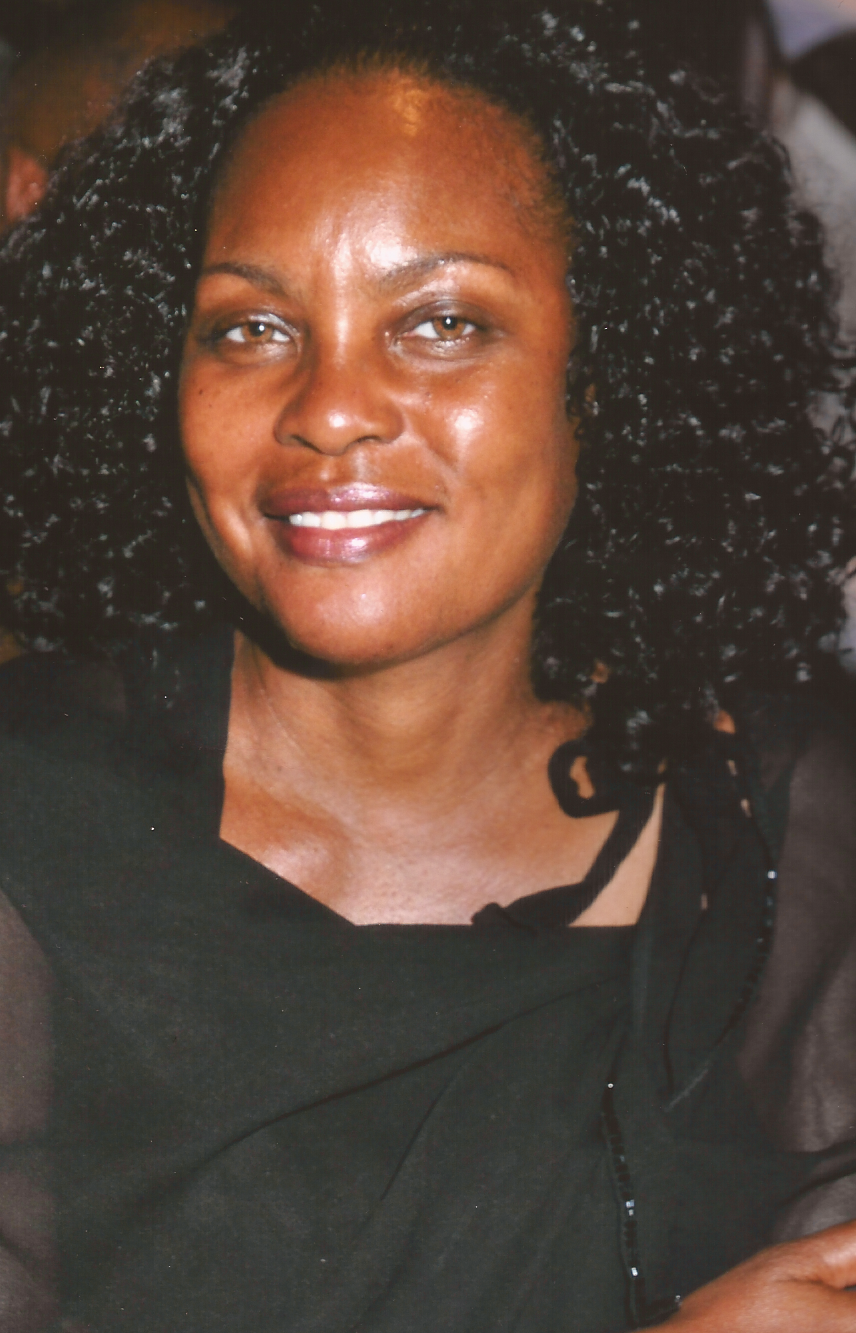
Darlene Black
Darlene Black was raised in the Society Hill section of Philadelphia, and is a graduate of Chatham College-located in Pittsburgh, PA. At Chatham she majored in Anthropology and Education. She is a former High School Science Teacher and, with her assistance, the students wrote science books for children. Her writings include: The Portrait Of Eternity, and The Sands Of Time-as part of the Anthologies- Gifts Of The Soul and The Fullness Of Time, published by The International Library of Poetry. Necromancy is the author’s first novel, and she is currently working on her second-Hollis Hill, while pursuing an advanced degree in chemistry. Darlene Black grew up in Philadelphia, Pennsylvania and attended her neighborhood school-General George A. McCall. After that, she enrolled at South Philadelphia High School-where she was an honor student, and served as a writer for the school’s newspaper, The Southeron. With the desire to continue her education, she traveled to Pittsburgh and became a student at Chatham College, where she majored in Anthropology and Education. Several years after graduating from Chatham, she began working at a medical center in the Thermography Department. While employed there, she opened a boutique where she designed and made clothing for women. However, it was at this point in her life, she discovered that she loved writing and not making clothing. She began writing Necromancy. The author, later, began teaching high school science, while determined to complete the novel. She has completed a manuscript for her second novel, Hollis Hill. Her other writings include: The Portrait of Eternity, and The Sands Of time-as part of the Anthologies- Gifts Of The Soul and The Fullness Of Time, published by The International Library of Poetry.
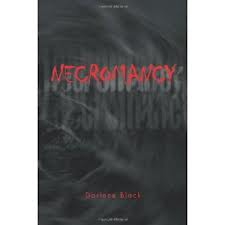
Necromancy
Mauly Basterville is a sophisticated architect who is contemplating calling-off his engagement to a beautiful woman, because he fears the company she keeps. Zemoria Charnes, an old, eccentric woman who was chased-out of the South because-it is believed-she was connected to an occult mass-suicide. However, Mauly suspects Zemoria coerced his fiancée to believe: she could maintain her relationships with the dead. To get the facts about Zemoria and her strange dealings-with hope that his fiancée will disassociate herself, Mauly hires a “hard-nosed” South Philly investigator-Pete Perrell. And what Pete unravels is beyond belief- the final phase of Satanism…Passing the Veil. Would you believe there are many people who secretly confess they were born with veils over their faces? Due to this, they claim to constantly witness uncanny things, such as sightings of the dead, angels and the spirit of Lucifer. Is this a spiritual blessing?-as some claim it to be-or is it some type of satanic attack? What if, a close friend told you an extremely tall being, draped in black, was seen looking through her bedroom window located on the second floor of her home? And, after the being busted through the window, standing to the chandelier, a voice said, “Who am I that cometh for your soul?” What advice would you give your friend? That is the situation Hatalie Mickens found herself in after Lansandra Mack told her the exact same thing. Hatalie replied, “Only two individuals can claim your soul: God or the devil. That light, hanging up there in that ceiling, is up there nine-feet. My favorite pastime is scripture research, and if you done as much research as I have; you´ll know Lucifer is nine-feet tall and he is going to get you.” Spooked by the incident, Lansandra traveled to the South to locate Zemoria Charnes-the woman that would guide her through the “Passing Of the Veil Ritual” which would free her of a peculiar life.
Q. I found out about your book “Necromancy” because one of your kids posted about you on a comment on another article about black horror writers. Were you surprised to find out you were on a list of “20 Black Women Horror Writers”?
A. Yes, I was surprised and thankful that my name was included on the list.
Q. Are you a big horror fan? What are some of your favorite writers in the genre?
A. I am a “big” horror fan, and I do admire all writers of the genre. I feel all horror writers contribute their own unique-spin to the genre.
Q. Like many women on our list, you also write poetry. What kinds of writing do you enjoy besides horror, and what can you tell us about your poetry?
A. I enjoy reading about science and history. Pertaining to poetry, I find myself writing about the concept of time.
Q. What inspired you to write “Necromancy”? Why did you choose the horror genre?
A. When I was a child, my grandmother and great-aunt would always tell me scary stories-which I believe left me with an interest in horror. With that, I wrote Necromancy based on a strange story my grandmother had told me.
Q. Were the places in the stories places that you’d been to in real life and were familiar with? Several of your characters are from Philadelphia like yourself – but you do any travel to help inspire you when dealing with characters like Zemoria Charnes, who was from the South?
A. Almost every place in Necromancy really exists in Philadelphia, and I have been to those places. (In example, Old City is one of my favorite places in Philadelphia.) Adding, I do include my travel as settings when writing.
Q. Did you have to do a lot of research into the occult and satanism when you were writing the novel?
A. I did interview individuals whom all claim to have been born, as many of the characters of Necromancy, with the ability to interact with the dead and angels.
Q. Are you still working on a second novel, “Hollis Hill”, and is the story related in any way to “Necromancy?”
A. I did complete it, and it is not related to Necromancy. It is a vampire novel.
Q. Do you have a website or a place where fans of your writing can find you on the Internet?
A. Yes. Goodreads and my Facebook.
You can buy it on Amazon
You can find it on Goodreads
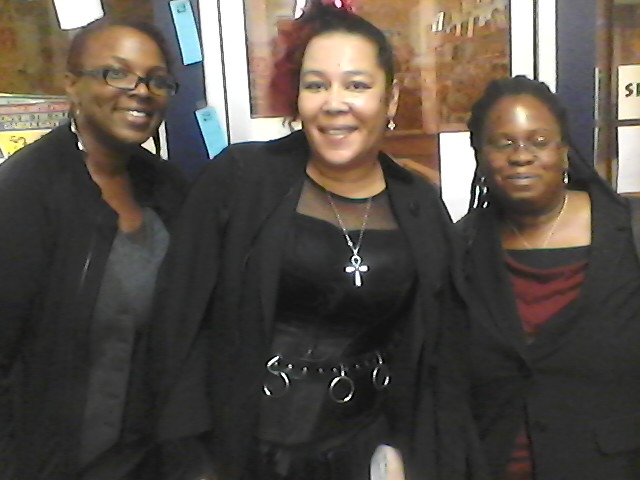

Sumiko and Andrea
Are you in the Oakland, California area? If you are, my friend Andrea and I are looking for a few more writers to fill out our writer’s group. We will be meeting at 5:30 pm every second Friday at the World Ground Cafe in the Laurel District, so our next meeting is March 8, 2013. If you want to join us, email me at sumikoska@yahoo.com and I can give you further information – or just come look for us, we won’t be the only ones in the cafe but there’s a photo of us so you can find us… and here’s the location of the cafe…
3726 MacArthur Blvd.
Oakland California 94619
And you can find a map and directions on their website:
http://www.worldgroundcafe.com/
 I go to Berkeley Community College (actually, so does Andrea – that’s where we met, although we both live in Oakland. I’m involved with my school paper now, which is pretty cool. They reprinted my article on “20 Black Women in Horror Writing.” The paper is called the BCC Voice. Technically, it is a newsletter – established by the student body to facilitate better communication between students. It’s editor in chief is Ksenya Yefimchyk – she’s in the same Shakespeare class as I am. If you are a student at BCC and are interested in the BCC Voice, the website is here:
 One of the most popular posts ever on this website (actually – the second most popular – the first most popular having been “Anne Rice regarding the Amazon review“) was “20 Black Female Horror Writers“. It’s follow up, “21 More Black Female Horror Writers” got about a tenth as many views, but I’m going to try to tweet them some more, with black history has tags (last time they had women in horror hash tags) and see if that helps. And maybe you can repost them, too. Please.
In school today, I talked about this in class and someone asked how many black women there were writing horror fiction, and I said, “I could find forty, not including myself”, so yea… forty, plus me. If there are any I missed well, please let me know. I’d also like to remind you again about the one, which is me. See that PayPal button over there? You can make a donation or, if you like, for only $10 +SH pick up a signed copy of my short story anthology “Things That Go Bump In My Head”, and it will help to pay for things like editors for my books (desperately needed), and me maintaining the internet here at home so I can keep blogging, thank you thank you.
I started about three, but I got caught up with the February interviews. But there will be one called “In Praise of Editors”, another called “Literacy Privilege” and a third one called “There’s a Bad Mood on the Rise” sometime, probably in the next week, in between these interviews.
Thank you.
This interview is being included in the 2013 Women in Horror Interview Series. Every February, Women in Horror Recognition Month (WiHM) assists underrepresented female genre artists in gaining opportunities, exposure, and education through altruistic events, printed material, articles, interviews, and online support. You can find out more about WiHM here:
http://www.womeninhorrormonth.com/
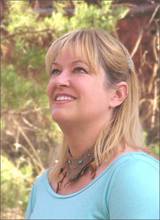
Wendy Pini
Wendy Pini is the writer and illustrator behind the futuristic adaptation of “Masque of the Red Death”. She’s also half of the husband-and-wife team behind the epic graphic novel/comic book series “ElfQuest” along with her husband, Richard Pini. The “ElfQuest” series takes place on alternate worlds and is in the science-fiction/fantasy genres. While “Masque” is also an entry into science-fiction, it represents the first work written entirely by Wendy, and embraces both the dark fantasy genre and the horror genre. The story is inspired by, but differs from the Edgar Allen Poe story of the same name. Wendy’s full biography (along with that of her husband) can be found here:
http://www.elfquest.com/about/Bios.html
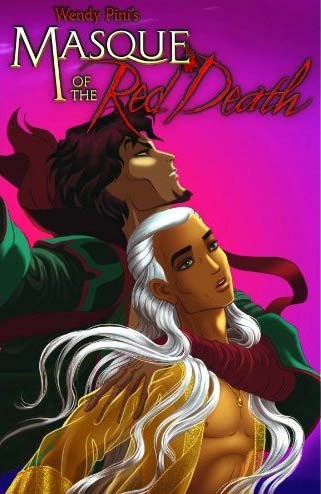
Masque of the Red Death
Masque of the Red Death
(based on the famous short story by Edgar Allan Poe)
On a futuristic earth-type world, in the vast, technologically overrun megalopolis of SIVARSI 9, citizens live what seems to be a utopian existence.
But Anton “Prince” Prosper, last scion of a fabulously wealthy, morally bankrupt dynasty, lusts for more. A scientific genius secluded from the world on his own, private island, Prosper dedicates his gifted young mind to perfecting the science of nanotechnology. His goal: eternal youth and immortality.
Aiding Prosper in his quest is his stunning assistant Steffan Kabala. Their intensely erotic, volatile relationship, seething with obsessive passion, finally explodes in an act of bitter revenge. Thus a hideous bio-technical plague, the Red Death, is unleashed upon an unsuspecting world.
The drama of jealousy, seduction, betrayal and conflicting ideals builds to a horrific climax amid the decadent delights of the most glamorous, most sinister masked ball ever held.
http://www.masque-of-the-red-death.com/
This is a first for this blog, “Things That Go Bump In My Head”…. the interview was done over the phone. The 30 minute audio interview will be transferred into a podcast and made available for iTunes in a couple of days, but for now you can listen to the whole thing on Youtube.
This interview is being included in the 2013 Women in Horror Interview Series. Every February, Women in Horror Recognition Month (WiHM) assists underrepresented female genre artists in gaining opportunities, exposure, and education through altruistic events, printed material, articles, interviews, and online support. You can find out more about WiHM here:
http://www.womeninhorrormonth.com/

L Marie Wood
L. Marie Wood has had a love for writing horror and suspense tales since she was a child. A Rockland County, New York native, she attended Howard University in Washington DC and, after graduating with a Communications degree in 1995, began writing with a focus on publication. Initially, her approach was through poetry, where she succeeded in publishing over twenty pieces under the pen name Elle Wood. She went on to write four screenplays and a novella before settling down to write the horror novel that dwelled within her for years. Her debut novel, Crescendo,received critical acclaim from such entities as Midwest Book Review and Buried.com.
The 2003 novel was called “a highly complex work” by Book Publicity, LTD. L. Marie Wood’s first short story collection, Caliginy, was released in November 2003 and was also nominated for a Stoker Award (2003). She has published over 100 short stories in anthologies and collections, both in print and online, such as The Black Spiral (alongside such horror greats as F. Paul Wilson and Sephera Giron) and on professional webzines such as Sinisteria.

The Promise Keeper
A young girl, on the cusp of sexual maturity, in what is now known as Benin, West Africa, is seduced by a beautiful stranger, a man the likes of which she has never seen before. Their encounter changes her forever. She becomes an asiman, a vampire: one of the undead.
The Promise Keeper comes to her, willing her to do his bidding — to keep an unspoken promise. He probes her mind and plants suggestions so she will follow his plan, until she fights back. She runs, her travels taking her to Europe and the Caribbean over centuries to escape him. She finally settles in New York City, convinced that she has eluded him… until she falls in love.
The Promise Keeper is a story of love, despair, murder, and deceit. It is also a vampire tale like no other. Could you keep this promise?”
Q. When I was putting together my article “20 Black Women in Horror Writing” I noticed that many horror writers choose not to use the genre label, but instead use the broader one “Speculative Fiction”. Do you think that reflects an attitude about the genre?
A. Absolutely. Sadly, horror is a genre that is still associated with stereotypical antagonists and predictable storylines. Likewise, it is a genre that most people would rather watch in a movie than read. The subtleties that reading good horror fiction can provide are missed in lieu of quick scares on the movie screen designed to make you jump. In that way, I believe that all literature suffers from popular cinematic trends. The many subgenres go unnoticed and vampires and zombies take forefront. Hence, if one is not interested in those antagonists, many think the horror genre has nothing to offer them. Many authors feel the need to distinguish themselves from genre norms to gain readership; a trend that has been on the upswing for years. What I would like to see is a shift in said norms to include quiet and psychological horror alongside visceral and gothic, to paint a broader picture of what the genre has to offer.
Q. You are closely associated with the genre label, and have even been nominated for one of it’s best known awards. How do you feel about horror? What made you decide to embrace writing in the genre?
A. I had no choice – indeed, horror chose me! I have been writing stories with a horror twist since I was 5 years old… little passages that always had an unexpected twist and always had some supernatural element. It is as much a part of who I am as is the color of my eyes. With that said, I love the genre. There are some subgenres that are not my particular taste, but overall, I love what the genre can do to the imagination. The way that it can awaken something inside, something that won’t go back where it came from once loosed (I am still afraid of mirrors after read an anonymous piece about reflections when I was a child!) is powerful to me. It keeps me coming back for more.
Q. Women are underrepresented in horror fiction, and black women even more so. Do you think that is beginning to change?
A. My honest answer to that is I don’t know. Black women are writing horror, without question. But getting readership, creating buzz, getting large press publishing deals is quite difficult for all writers, but especially in this group. In the past, I was told that because there was already one Black female horror writer on staff, they didn’t think they needed another one. I hope to see this dynamic change.
Q. You are very prolific, with an impressive body of work that includes half a dozen short story anthologies in addition to your novels, “Crescendo” and “The Promise Keeper”. What keeps you inspired?
A. Life. Story ideas come from everywhere. I love to watch people but my method is not as blatant as it sounds. Any outing provides the chance to observe behavior. All behavior can be seen in a positive or negative light. As a psychological horror author, I enjoy the twists and turns the mind can take, so I watch to see where the world takes me. For instance, I am on a train right now heading east through rural country with a smattering of stores every couple of miles. Barren trees revealing a two lane road travelled by few cars. A young man walking through the woods. There are so many places I could go with that.
Q. Let’s talk about your second novel, “The Promise Keeper”. It’s protagonist Zaji hails from what would become Benin. She is an asiman, a vampire-like creature of African legend, traditionally able to enter the bodies of animals. Did you have to do a lot of research about the asiman to craft this modern tale based upon ancient legend?
A. Yes, but to me, to write anything, you must first research. Authenticity is key, even if you don’t intend to follow the same footsteps as what is already in place. My research focused around the Fon language, more so than the asiman legend, however the legend provided a base for the character. The rich culture, historical religious construct, and lore contributed to the formation of Zaji’s homeland in “The Promise Keeper”.
Q. Is Zaji like or unlike the vampires in modern lore? As an asiman, do her powers and weaknesses differ from the European vampire legends?
A. Zaji is has more in common with a modern vampire than the historical depictions, however there are definite similarities with the latter as well. Zaji can walk during the day and can sustain herself without partaking of blood for longer periods of time. Zaji can consummate relationships and control her anger. But like her ancestors in Europe, blood calls to her and love is her undoing. Her maker, however, The Promise Keeper himself, is unlike any vampire ever written because he is, in fact, more than a vampire. He is something more sinister, more terrifying.
Q. Benin holds an important place in history – particularly in art history because of the Edo people of the pre-colonial Benin City-State and the Benin Empire, which demonstrated a greater level of sophistication in understanding of the human anatomy and imbued the sculpture with finer suggestion of human spirit in it’s subtle facial expression than was known in most of the world at that period of time, during the late middle ages. Does your story involve the Edo and the Benin Empire?
A. Loosely. The culture serves as a backdrop for the larger story that is Zaji and her interaction with a beautiful stranger.
Q. Where can our readers find you and your books on the internet?
A. Goodreads is my current web presence, as well as the L. Marie Wood reader group on Facebook. My books can be found on Amazon.com (paperback, Kindle), Google Books (Nook), and E-Volve Books (paperback, Kindle, Nook).
Q. Is there anything you’d like to tell the readers that we haven’t covered yet?
A. My third short story collection, “Anathema”, was released by E-Volve books at the end of 2012. It is a grouping of 35 short stories of varying lengths and in several sub-genres. I hope you enjoy. Thank you very much for the interview! I truly appreciate being selected and I look forward to reading your article.
Recently I published an article in honor of Black History Month and Women in Horror Month called “20 Black Women in Horror Fiction“. While the first list consisted almost entirely of women whose works have been published solo book length collections such as novels, and single author short story and poetry anthologies (with the exception of Angela C. Allen), this list consists primarily of women whose works of horror were published in multiple-author black writer horror showcases, including “Dark Thirst”, “Dark  Matter”, and “Dark Dreams.” Many of the women on this second list are women who are frequent contributors to a variety of short story compilations, and women who write primarily in another genre, but have also contributed short horror for to the anthologies.
You can find the first article HERE: 20 Black Women in Horror Fiction
This list has expanded to include two other lists for a total of 60 women.
20 Black Women in Horror Fiction (List 1)
21 More Black Women In Horror Fiction (List 2)
19 More Black Women in Horror Fiction (List 3)
I am working on an eBook alphabetically listing all 60 women. If you can think of anyone who should be on this list but is not, please leave it in the comments for either article or send me a tweet @sumikoska or – email me sumikoska@yahoo.com and let me know.

Zora Neale Hurston
Best known for her critically acclaimed “Their Eyes Were Watching God”, a book that is so much in the canons of literary history that it is assigned reading for many classes on the topic, she was frequently involved in anthropological research into oral lore of African diaspora cultures. Her collection of African American folklore “Every Tongue Gotta Confess” includes stories about witches and ghosts (or “haunts). In 1937 she was awarded the Guggenheim Fellowship to conduct anthropological studies of Jamaica and Haiti. She came back and wrote the non-fiction work “Tell My Horse“. The book gives a personal account of her dealings with voodoo and zombies. Yes, zombies. Not the George Romero kind – the West Craven kind. In fact, here is an audio recording of Zora Neal Hurston discussing zombies.
Sheree R. Thomas
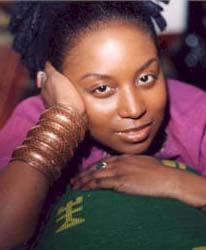
Ledig House/LEF Foundation award winning writer, editor and small publisher Sheree R. Thomas is the reason many of the women on this list are here: her innovative and game-changing and multiple award winning “Dark Matter” series is one of the most influential anthologies of African American speculative fiction to date. In addition to her work on this powerful collection, she stands as a horror writer in her own right. Her work, “Black River Ritual” also received Honorable Mention in The Year’s Best Fantasy & Horror: Sixteen Annual Collection (St. Martin’s Griffin, 2003).
http://aalbc.com/authors/Sheree.htm
Nisi Shawl
James Tiptree, Jr. Award winner and World Fantasy award nominee Nisi Shawl most often writes science-fiction, with frequent excursions in the related genres of horror, fantasy, and dark fantasy. Her short story “Deep End”, a terrifying vision of dystopic future colonialism is as frightening as any episode of “The Twilight Zone” ever was. Her collection “Filter House” has more than a horror stories in it, including “Wallamelon”, and 2005 Year’s Best Fantasy & Horror award winner “Cruel Sista”.
“Maggies” was her contribution to Dark Matter.
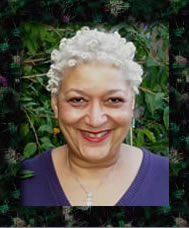
Jewelle Gomez
Activist Jewelle Gomez won the Lambda Award for her stories about a black lesbian vampire named Gilda, “The Gilda Stories”. Gilda makes a reappearance in the traditional and fantasy short story collection “Don’t Explain”. Well known as a writer of lesbian erotica and poetry, she also contributed a story about the independent woman vampire, “Chicago 1927”, to the anthology of African Diaspora speculative fiction “Dark Matters”. Vampires are the supernatural creature most likely to dance across the line horror and paranormal erotica meet due to the sexually charged nature of the creature. Jewelle Gomez’ “Gilda” is certainly no exception.
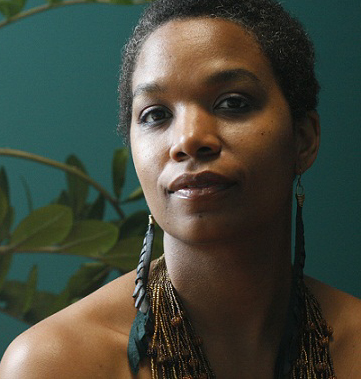
Kiini Ibura Salaam
This speculative fiction, erotica, creative nonfiction, and poetry writer prefers to work outside of the confines of genre, however her inclusion in publications like “Dark Matter” and the critically acclaimed Nalo Hopkinson voodoo tale anthology “Mojo: Conjure Stories” are for her work in the realm of dark fantasy and horror. She effortlessly moves from genre to genre without stopping to concern herself with how others choose to label her speculative fiction, which certainly contains many aspects of science-fiction as well. Certainly this can be said of At Life’s Limits, her contribution to the Dark Matter anthology. Wings, Nectar, & Ancestors is another story available on her website, from her own anthology “Ancient, Ancient” which includes otherworldly stories rooted in science-fiction, dark fantasy, magic and yes, horror. It was named one of the Best Fantasy and Science Fiction Books of 2012 by Jeff VanderMeer.

Ibi Zoboi
Haitian-American Speculative Fiction writer Ibi Zoboi was born in Port-au-Prince, Haiti and her short stories have been anthologized in Dark Matter: Reading the Bones, Haiti Noir, and The Caribbean Writer among others. Her blog “Tell My Horse” is named after the Zora Neale Hurston book mentioned above. “The Fire In Your Sky” is a delightful example of the writer’s skill at mixing realism with horrific mythological dark fantasy – it is the true-to-life situations that the characters reside in before suddenly finding themselves in the middle of the terrifyingly surreal that gives her fiction the jolting quality of traditional horror.

Lexi Davis
Paranormal romance novelist Lexi Davis’ cautionary tale “Are You My Daddy?” graced the pages of Dark Dreams III. Her debut novel, “Pretty Evil” is about three guys who get on the wrong size of a female demon and was nominated for the “Best First Novel” African American, Romantic Times Book Club Reviewer’s Choice Awards. Her second novel, “The After Wife” is about Nia Youngblood the daughter of a witch who has some serious problems. For one thing, when she was born, her mother promised her hand in marriage to a demon named Rephaim. For another, she’s not dying to marry him – which is a big problem for him, because she’d have to die to marry him. He wants to marry her in the after life.

Leone Ross
Award-winning speculative fiction and erotica writer Leone Ross is of Jamaican and Scottish heritage and has written short stories for The Year’s Best Fantasy and Horror (14th Edition) and Dark Matter. “Orange Laughter” is a gripping psychological drama about Tony Pellar, a man sinking into madness and desperately trying to escape a ghostly figure he calls the “soul snatcher”. This novel and several of her short stories contain the kind of dark journeys into the realm of human perception as to qualify as psychological horror, where neither the protagonist nor the reader is at various points sure if the man is haunted by spirits or his own tortured mind. Her entry to Dark Matter was called “Tasting songs”.
http://literature.britishcouncil.org/leone-ross
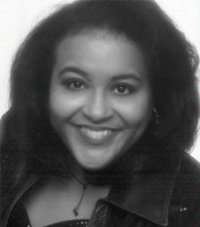
Monica Jackson
Contemporary fiction and romance novelist’s Monica Jackson’s entry into the “Dark Thirst” collection also included something else that belongs in horror – humor. “The Ultimate Diet” is the story of a chubby computer programmer who is longing to be thin when a strange woman moves in across the street – a strange, blood-sucking woman. This skewering bit of satirical humor parodies the American woman’s obsession with getting thin by any means necessary. She also writes paranormal romance titles. “A Magical Moment” and “Heart’s Desire” feature a protagonist with psychic gifts and a compelling back story. This is the story of a battered woman who is hiding from her abuser in a shelter when a serial killer threatens her and her new love interest – a grade a suspense story line. “A Magic Moment” is definitely intrigues as a paranormal bodice ripper,

Donna Hill
The incredibly prolific Donna Hill is a pioneer of the African American romance genre, with more than fifty tiles to her name over the past thirty years – now, just let that sink in for a minute. At a rate of a novel and a half per year, she writes like books faster than some of us can read them, and does something some of us only dream of: she works full time as a writer. Three of her books were made into movies. Somehow, on top of that she’s found the time to write short stories for the horror anthologies: “Dark Thirst” and “Creepin”.

Akua Lezli Hope
Poet, writer, and hand papermaker Akua Lezli Hope is a founding member of the Black Writers Union and the New Renaissance Writers Guild. She is one of the writers in the short story anthology “Dark Matter: A Century of Speculative Fiction from the African Diaspora.” Her surrealistic near-future tale “The Becoming” got Honorable Mention for The Year’s Best Fantasy and Horror Award. The third generation New Yorker received two visual arts grants before receiving a Creative Writing Fellowship from The National Endowment For The Arts in 1990. She received an Artists Crossroads Grant (2003) from The Arts of the Southern FingerLakes for her project “Words on Motion,” which placed poetry on buses in New York.
http://www.artfarm.com/akualezlihope.html
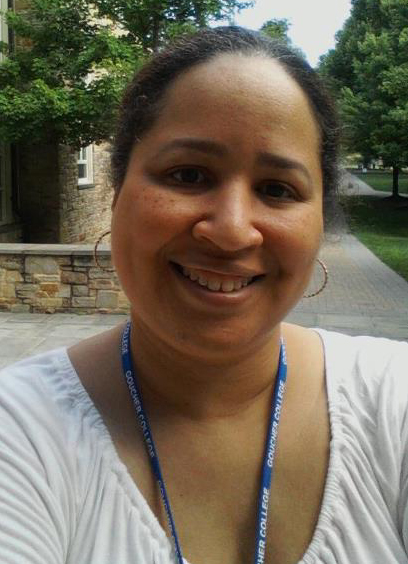
Lawana Holland-Moore
American short story writer Lawana Holland-Moore contributed stories to all three of the “Dark Dreams” paranormal horror and suspense anthologies. Her contributions were “Empty Vessel” (Dark Dreams), “Breath of Life” (Dark Dreams II), and “Flight” (Dark Dreams III). She is also a visual artist – into the craft of quilting. Her blog, “Ghosthunter L” is a about real-life haunted houses and paranormal activity. She is considered a national expert on ghosts and hauntings of the Metropolitan Washington, D.C. area and has been featured in the Washington Post, Times, and USA Today. Her Dark Dreams II entry, “Breath of Life” was mentioned by “Beyond Victoriana (A Multicultural Perspective on Steampunk)” in it’s article on the Weird Wild West, “Pale Ghosts and Broader Frontiers”.
http://distilledlife.wordpress.com
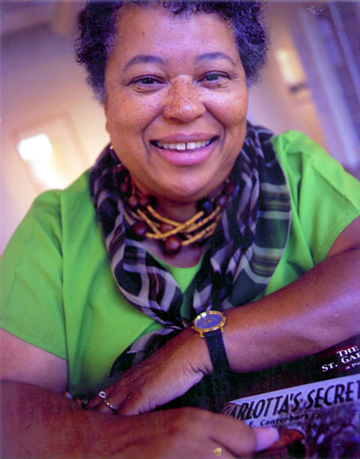
Patricia Canterbury
Award winning poet,short story writer, novelist, philanthropist and political scientist Patricia E. Canterbury contributed the story “Wild Chocolate” to the “Dark Dreams” anthologies of paranormal horror and suspense. It is the story of a visit to a remote village in the Brazilian jungle and what happens to a married couple, and of the power of pure love. Her primary genre is mystery, with one murder mystery title “Every Thursday”, two young adult titles, and two children’s mysteries. Carlotta’s Secret the first of her children’s eight chapter book contemporary fantasy mystery series, The Delta Mysteries. A small independent motion picture studio has optioned Carlotta’s Secret. She won the First Annual Georgia State Chapbook contest in 1987 for her poetry chapbook, Shadowdrifters…Images of China.
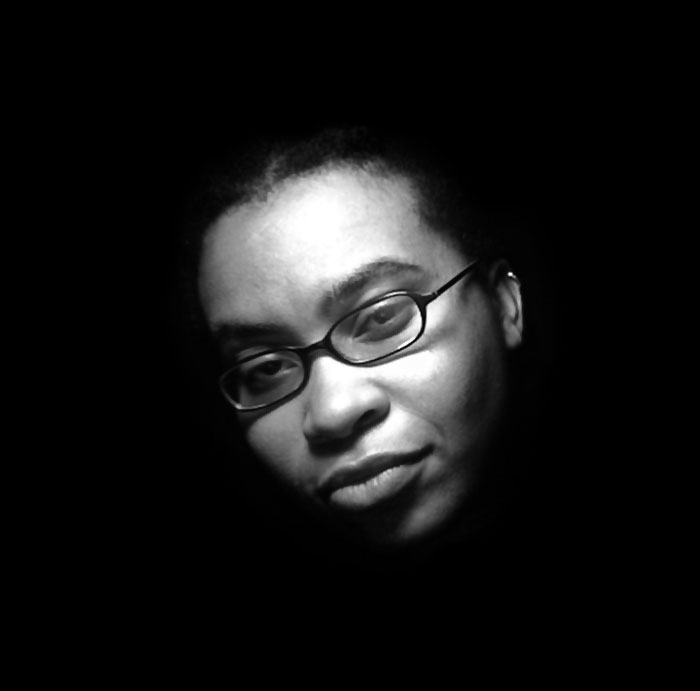
Tenea D Johnson
Dark futures dominate the landscape of Tenea D. Johnson’s speculative fiction: apocalyptic futures, dystopic futures, and dark fantasies… all of that good stuff horror is made of. “The Taken” was her contribution to Dark Dreams III. Publisher’s Weekly dubbed the short story a “provocative meditation on revenge”. “R/evolution” is her novel-length entry into the creepier aspects of science-fiction, taking place in a future USA marred by increasingly stark class divisions exasperated by the economic and racial divide when it comes to access to advanced new biogenics.
Pam Noles
Horror and science-fiction Pam Noles contributed “Whipping Boy” to the collection “Dark Matter: Reading the Bones”. She is a professional journalist living in Los Angeles these days, and writes a lot of non-fiction. She is also a blogger, and her blog “And We Shall March On… (Black, Geek, and Fine With That)” frequently discusses horror and popular culture, in addition to politics, community, and the Occupy Movement. Her fiction has appeared in anthologies from Warner Books, Dark Horse Comics, Terra Major, and Pulphouse. You can read her science fiction story “Shame” online in Infinite Matrix.
http://andweshallmarch.typepad.com/

Cherene Sherrard-Johnson contributed “The Quality of Sand” to the horror anthology “Dark Matter: Reading the Bones.” She is Professor of English at the University of Wisconsin-Madison where she teaches nineteenth and twentieth century American and African American literature, cultural studies and feminist theory. While horror is not her usual genre, she is an accomplished author. She is the author of a poetry chapbook, “Mistress, Reclining” (Winner of the New Woman’ s Voices Award Finishing Line Press, 2010), Portraits of the New Negro Woman: Visual and Literary Culture in the Harlem Renaissance (Rutgers UP, 2007) and Dorothy West’ s Paradise: A Biography of Class and Color (Rutgers UP 2012): a biography of Harlem Renaissance writer Dorothy West.

Zane
New York Times and Essence bestselling author Zane achieved what many independent publishing writers only dream of: she self-published The Sex Chronicles before landing a deal with Simon & Schuster. She is primarily a writer of erotica, but she contributed “Resident Evil”, a tale of vampirism, to the “Dark Dreams : A Collection of Horror and Suspense by Black Writers”. The rest of her writing consist entirely of erotic fiction, which also figures heavily into her vampire story. She also has a sex advice column in her blog, which you can find at her website Erotica Noir.
Ama Patterson
Ama Patterson contributed “Hussy Strutt” to the Dark Matter collection. She attended the Clarion West Writers Workshop in 1999. Her short fiction is included in 80! Memories and Reflections on Ursula K. Le Guin (Karen Joy Fowler and Debbie Notkin, editors, Aqueduct Press). She is the author of “Zen and the Art of Haiku: Journal” and three other how to and inspirational books, “The Lost Art of I Ching,” “The Essential Guide to Astrology,” and “Finding Your Inner Goddess: A Journal of Self-Empowerment“.
http://www.clarionwest.org/node/1341/view

Jill Robinson
She contributed the story “BLACKout” to “Dark Matter: Reading the Bones”. It is about reparations becoming a reality and the issues that might arise if it should. She has also contributed short fiction to “Role Call: A Generational Anthology of Social and Political Black Literature and Art,” and ANANSI: Fiction of the African Diaspora.
http://aalbc.com/reviews/paths_of_sanctuary.htm#Jill
Short horror fiction author Joy M. Copeland has been included in a the horor anthologies, “Dark Dreams” and “To Hell In a Fast Car“. She also wrote a series of books on histories of select members of the Teamsters Union.
Tish Jackson wrote “The Love of a Zombie Is Everlasting” for “Whispers in the Night (A Dark Dreams Anthology #3) “.
http://www.goodreads.com, http://www.amazon.com and http://www.wikipedia.org, all three of whom were critical to research for this article, but most especially Goodreads, from which I gathered the author lists for the anthologies.
Famous Last Words:
As far as I know these two list combined are comprehensive – but if I missed someone PLEASE let me know. Also, if you know anything about Tish Johnson and Joy M. Copeland that I can add to the article please let me know.
 Sumiko Saulson